Industry
iGaming
Client
Casino Room • Online Casino Platform
UX and Product Design for a Data-Driven iGaming Experience

Conversion-Focused Product Redesign for an Online Casino Platform
Reversing declining engagement and improving business performance through iterative UX optimisation, experimentation, and continuous product development.
Overview
Casino Room is an online casino platform that evolved from a poker product launched in 2005. Years of rapid growth and expansion into multiple markets resulted in an inconsistent user experience, fragmented interfaces, and outdated design patterns.
I joined the team as a Product Designer to help modernise the product, optimise key conversion journeys, introduce a scalable design foundation, and support business growth through continuous experimentation and iterative improvements.
Overview
Casino Room is an online casino platform that evolved from a poker product launched in 2005. Years of rapid growth and expansion into multiple markets resulted in an inconsistent user experience, fragmented interfaces, and outdated design patterns.
I joined the team as a Product Designer to help modernise the product, optimise key conversion journeys, introduce a scalable design foundation, and support business growth through continuous experimentation and iterative improvements.

The Challenge
The platform had been developed over many years with a strong focus on operational needs and market expansion rather than user experience. As a result, critical journeys such as registration, login, and deposits contained unnecessary friction, visual inconsistencies, and usability issues.
At the same time, the business faced declining customer numbers, increasing competition, and a growing shift toward mobile-first behaviour. Improving acquisition, retention, and conversion required more than a visual refresh - it required systematic product design driven by research and measurable outcomes.
The Challenge
The platform had been developed over many years with a strong focus on operational needs and market expansion rather than user experience. As a result, critical journeys such as registration, login, and deposits contained unnecessary friction, visual inconsistencies, and usability issues.
At the same time, the business faced declining customer numbers, increasing competition, and a growing shift toward mobile-first behaviour. Improving acquisition, retention, and conversion required more than a visual refresh - it required systematic product design driven by research and measurable outcomes.

My Role
As the lead Product Designer on the project, I worked across multiple areas of the product lifecycle, including UX improvements, UI design, branding, and design system development.
My responsibilities included:
Optimising registration, login, and deposit experiences across multiple markets.
Establishing reusable UI components and an asset library to improve consistency and scalability.
Rebranding the platform with a new visual identity, including logo, colour palette, and typography.
Improving Live Casino experiences and promotional surfaces.
Collaborating closely with UX researchers, developers, legal teams, customer support, and stakeholders to validate solutions and prioritise improvements.
My Role
As the lead Product Designer on the project, I worked across multiple areas of the product lifecycle, including UX improvements, UI design, branding, and design system development.
My responsibilities included:
Optimising registration, login, and deposit experiences across multiple markets.
Establishing reusable UI components and an asset library to improve consistency and scalability.
Rebranding the platform with a new visual identity, including logo, colour palette, and typography.
Improving Live Casino experiences and promotional surfaces.
Collaborating closely with UX researchers, developers, legal teams, customer support, and stakeholders to validate solutions and prioritise improvements.

Research & Insights
Product decisions were informed by behavioural data, customer support feedback, market-specific insights, and dedicated UX research.
The analysis highlighted several opportunities:
Registration and deposit flows suffered from unnecessary complexity.
Mobile users required a simpler and more focused experience.
Live Casino lacked visibility despite representing a valuable customer segment.
Existing interfaces lacked consistency, increasing cognitive load and reducing trust.
These findings helped prioritise work around the journeys with the greatest impact on conversion and retention.
Research & Insights
Product decisions were informed by behavioural data, customer support feedback, market-specific insights, and dedicated UX research.
The analysis highlighted several opportunities:
Registration and deposit flows suffered from unnecessary complexity.
Mobile users required a simpler and more focused experience.
Live Casino lacked visibility despite representing a valuable customer segment.
Existing interfaces lacked consistency, increasing cognitive load and reducing trust.
These findings helped prioritise work around the journeys with the greatest impact on conversion and retention.

Optimising Core User Flows
Registration
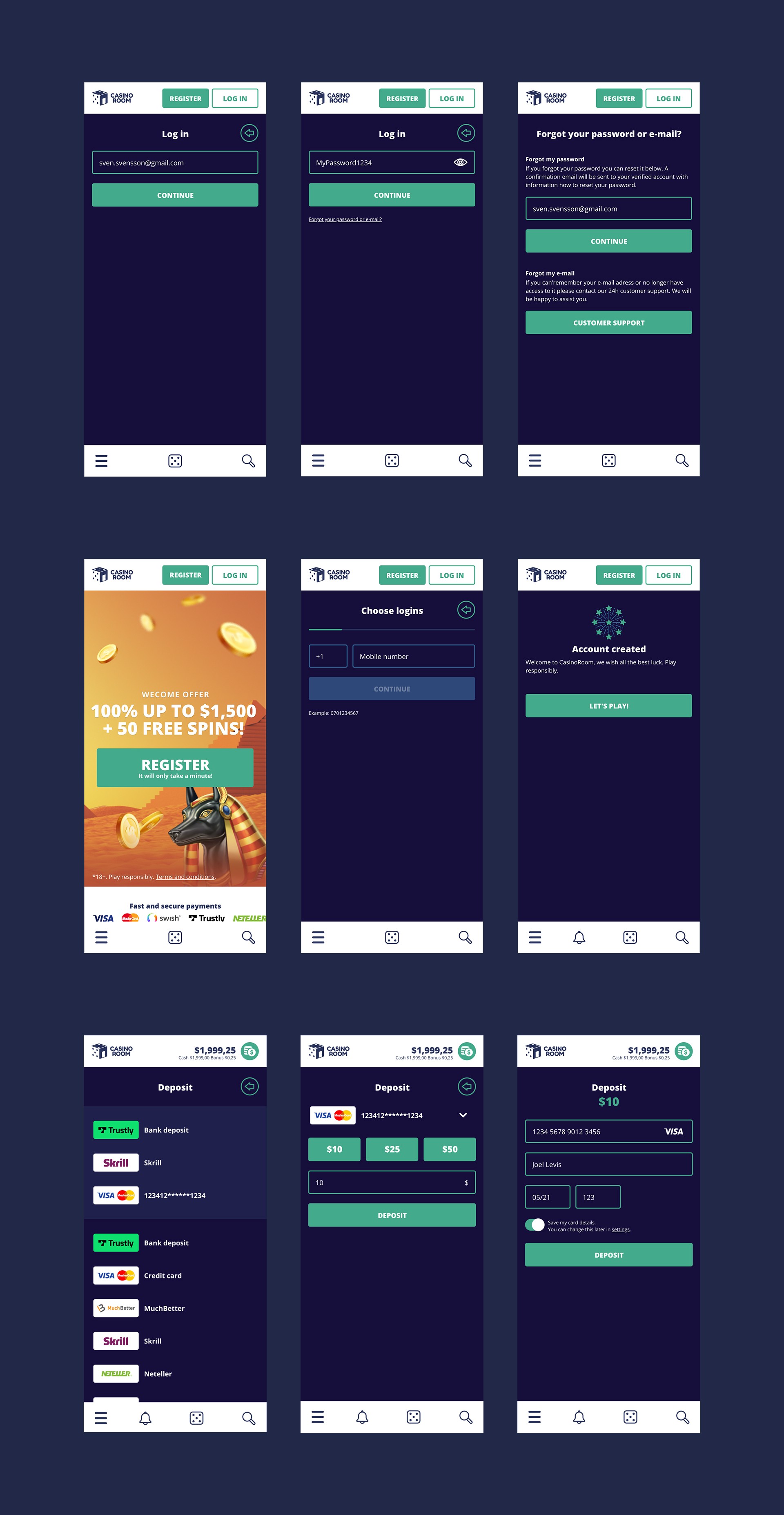
The previous registration experience presented all required information on a single screen, creating unnecessary complexity and increasing abandonment.
I redesigned the flow into a progressive multi-step experience, reducing cognitive load and guiding users through one decision at a time. Additional market-specific improvements, including BankID optimisation and deposit integration for first-time users, further increased conversion performance.
Login
The login experience was redesigned to align visually and behaviourally with registration while simplifying password recovery and reducing friction for returning users.
For BankID authentication, maintaining consistency between registration and login created a more predictable and intuitive experience.
Deposits
The deposit flow was completely restructured to improve efficiency and flexibility.
Users could access payment methods earlier in the process, switch methods without restarting the flow, and quickly choose predefined deposit amounts. These improvements reduced friction and supported faster decision-making during one of the product's most business-critical interactions.
Optimising Core User Flows
Registration
The previous registration experience presented all required information on a single screen, creating unnecessary complexity and increasing abandonment.
I redesigned the flow into a progressive multi-step experience, reducing cognitive load and guiding users through one decision at a time. Additional market-specific improvements, including BankID optimisation and deposit integration for first-time users, further increased conversion performance.
Login
The login experience was redesigned to align visually and behaviourally with registration while simplifying password recovery and reducing friction for returning users.
For BankID authentication, maintaining consistency between registration and login created a more predictable and intuitive experience.
Deposits
The deposit flow was completely restructured to improve efficiency and flexibility.
Users could access payment methods earlier in the process, switch methods without restarting the flow, and quickly choose predefined deposit amounts. These improvements reduced friction and supported faster decision-making during one of the product's most business-critical interactions.
Building a Scalable Design Foundation
When I joined, the product lacked a structured component library or reusable design standards.
To improve consistency and accelerate delivery, I introduced a shared asset library that standardised interface elements and reusable components across the platform. This approach streamlined prototyping, reduced duplication, and made future iterations significantly easier for both design and development teams.
Accessibility considerations were incorporated throughout the redesign, with colour and contrast decisions aligned with WCAG recommendations wherever possible.
Building a Scalable Design Foundation
When I joined, the product lacked a structured component library or reusable design standards.
To improve consistency and accelerate delivery, I introduced a shared asset library that standardised interface elements and reusable components across the platform. This approach streamlined prototyping, reduced duplication, and made future iterations significantly easier for both design and development teams.
Accessibility considerations were incorporated throughout the redesign, with colour and contrast decisions aligned with WCAG recommendations wherever possible.

Rebranding the Platform
Alongside UX improvements, I led the visual refresh of Casino Room.
The rebrand included a new logo inspired by the concept of opportunity and chance, an updated colour palette designed to communicate trust and optimism, and a modern typography system that improved readability across the product.
The objective was not only to modernise the appearance but also to establish a more cohesive and recognisable brand identity that could scale across marketing and product experiences.
Rebranding the Platform
Alongside UX improvements, I led the visual refresh of Casino Room.
The rebrand included a new logo inspired by the concept of opportunity and chance, an updated colour palette designed to communicate trust and optimism, and a modern typography system that improved readability across the product.
The objective was not only to modernise the appearance but also to establish a more cohesive and recognisable brand identity that could scale across marketing and product experiences.

Enhancing the Live Casino Experience
Research indicated that Live Casino players represented a particularly valuable customer segment but that the experience lacked clarity and discoverability.
I redesigned the category by introducing clearer visual hierarchy, colour-coded operator indicators, and live table previews where available. These changes helped users identify preferred games more quickly and reinforced the real-time nature of the experience.
Enhancing the Live Casino Experience
Research indicated that Live Casino players represented a particularly valuable customer segment but that the experience lacked clarity and discoverability.
I redesigned the category by introducing clearer visual hierarchy, colour-coded operator indicators, and live table previews where available. These changes helped users identify preferred games more quickly and reinforced the real-time nature of the experience.

Continuous Experimentation
Rather than relying on large redesigns alone, the team embraced continuous product development through incremental testing and optimisation.
Examples included:
Simplifying registration flows to improve completion rates.
Refining deposit amount selections based on user behaviour.
Testing promotional messaging and placement to increase successful registrations and deposits.
Iterating on onboarding experiences across different regional markets.
Not every experiment succeeded, but each test generated insights that informed future decisions and reduced uncertainty.
Continuous Experimentation
Rather than relying on large redesigns alone, the team embraced continuous product development through incremental testing and optimisation.
Examples included:
Simplifying registration flows to improve completion rates.
Refining deposit amount selections based on user behaviour.
Testing promotional messaging and placement to increase successful registrations and deposits.
Iterating on onboarding experiences across different regional markets.
Not every experiment succeeded, but each test generated insights that informed future decisions and reduced uncertainty.

Outcomes
The redesign delivered measurable improvements across both user engagement and business performance. Monthly tracking of key metrics, including Unique Depositing Customers (UDC), Deposits, Gross Gaming Revenue (GGR), and Net Gaming Revenue (NGR), showed a clear upward trend following the rollout of the major UX and UI initiatives.
Continuous experimentation played a key role in these results. Rather than relying on large, one-off redesigns, improvements were introduced incrementally, validated through testing, and refined based on performance data.
Several experiments produced particularly strong outcomes:
A welcome offer banner introduced at the beginning of the registration flow increased successful registrations by 70% in the Latin American market.
Displaying a bonus pop-up after a short period of inactivity during registration led to a 25% increase in successful deposits.
Adjusting the predefined deposit amount from 400 SEK to 300 SEK nearly doubled the number of successfully completed deposits.
Not every experiment produced the expected outcome, but each contributed valuable insights that informed future iterations. This continuous optimisation approach helped create a more effective product experience while supporting sustainable business growth.
Outcomes
The redesign delivered measurable improvements across both user engagement and business performance. Monthly tracking of key metrics, including Unique Depositing Customers (UDC), Deposits, Gross Gaming Revenue (GGR), and Net Gaming Revenue (NGR), showed a clear upward trend following the rollout of the major UX and UI initiatives.
Continuous experimentation played a key role in these results. Rather than relying on large, one-off redesigns, improvements were introduced incrementally, validated through testing, and refined based on performance data.
Several experiments produced particularly strong outcomes:
A welcome offer banner introduced at the beginning of the registration flow increased successful registrations by 70% in the Latin American market.
Displaying a bonus pop-up after a short period of inactivity during registration led to a 25% increase in successful deposits.
Adjusting the predefined deposit amount from 400 SEK to 300 SEK nearly doubled the number of successfully completed deposits.
Not every experiment produced the expected outcome, but each contributed valuable insights that informed future iterations. This continuous optimisation approach helped create a more effective product experience while supporting sustainable business growth.

Reflection
Casino Room reinforced my belief that meaningful product improvements rarely come from large redesigns alone. Instead, lasting impact is achieved through continuous optimisation, close cross-functional collaboration, and decisions grounded in user behaviour and measurable outcomes.
Working on a highly regulated, business-critical product required balancing conversion goals, compliance requirements, and user needs while delivering solutions that could scale across multiple markets. The experience strengthened my approach to product design as an iterative process where every improvement is treated as a hypothesis to be validated through data and experimentation.
Reflection
Casino Room reinforced my belief that meaningful product improvements rarely come from large redesigns alone. Instead, lasting impact is achieved through continuous optimisation, close cross-functional collaboration, and decisions grounded in user behaviour and measurable outcomes.
Working on a highly regulated, business-critical product required balancing conversion goals, compliance requirements, and user needs while delivering solutions that could scale across multiple markets. The experience strengthened my approach to product design as an iterative process where every improvement is treated as a hypothesis to be validated through data and experimentation.
