Industry
Construction Technology
Client
Skanska • Design Sprint
AI-Assisted Workflows for Construction Teams

The Challenge
Skanska set out to replace an aging internal management platform that had become fragmented, difficult to navigate, and poorly connected across teams. Employees relied on multiple disconnected modules, struggled to find relevant information, and lacked a unified workflow supporting projects from tender through warranty. The ambition was to create a single digital environment that would guide employees with procedures, templates, checklists, and best practices while supporting day-to-day collaboration across construction projects. The concept was developed during a two-day Design Sprint in Copenhagen, where multidisciplinary teams worked under significant time constraints to explore future product directions.

My Role
As part of the Design Sprint team, I collaborated on shaping the product concept from early ideation through to prototyping. Working alongside designers, strategists, and client stakeholders, I contributed to workshops, brainstorming sessions, and solution exploration, helping translate research insights into practical product ideas.
I was particularly involved in defining the experience for Project Managers on construction sites, focusing on workflows, information architecture, and interaction design. Beyond creating wireframes and high-fidelity interfaces, I explored opportunities to increase engagement through gamification and developed supporting visuals, illustrations, and responsive concepts that brought the overall vision to life.
My Role
As part of the Design Sprint team, I collaborated on shaping the product concept from early ideation through to prototyping. Working alongside designers, strategists, and client stakeholders, I contributed to workshops, brainstorming sessions, and solution exploration, helping translate research insights into practical product ideas.
I was particularly involved in defining the experience for Project Managers on construction sites, focusing on workflows, information architecture, and interaction design. Beyond creating wireframes and high-fidelity interfaces, I explored opportunities to increase engagement through gamification and developed supporting visuals, illustrations, and responsive concepts that brought the overall vision to life.

Discovery & Research
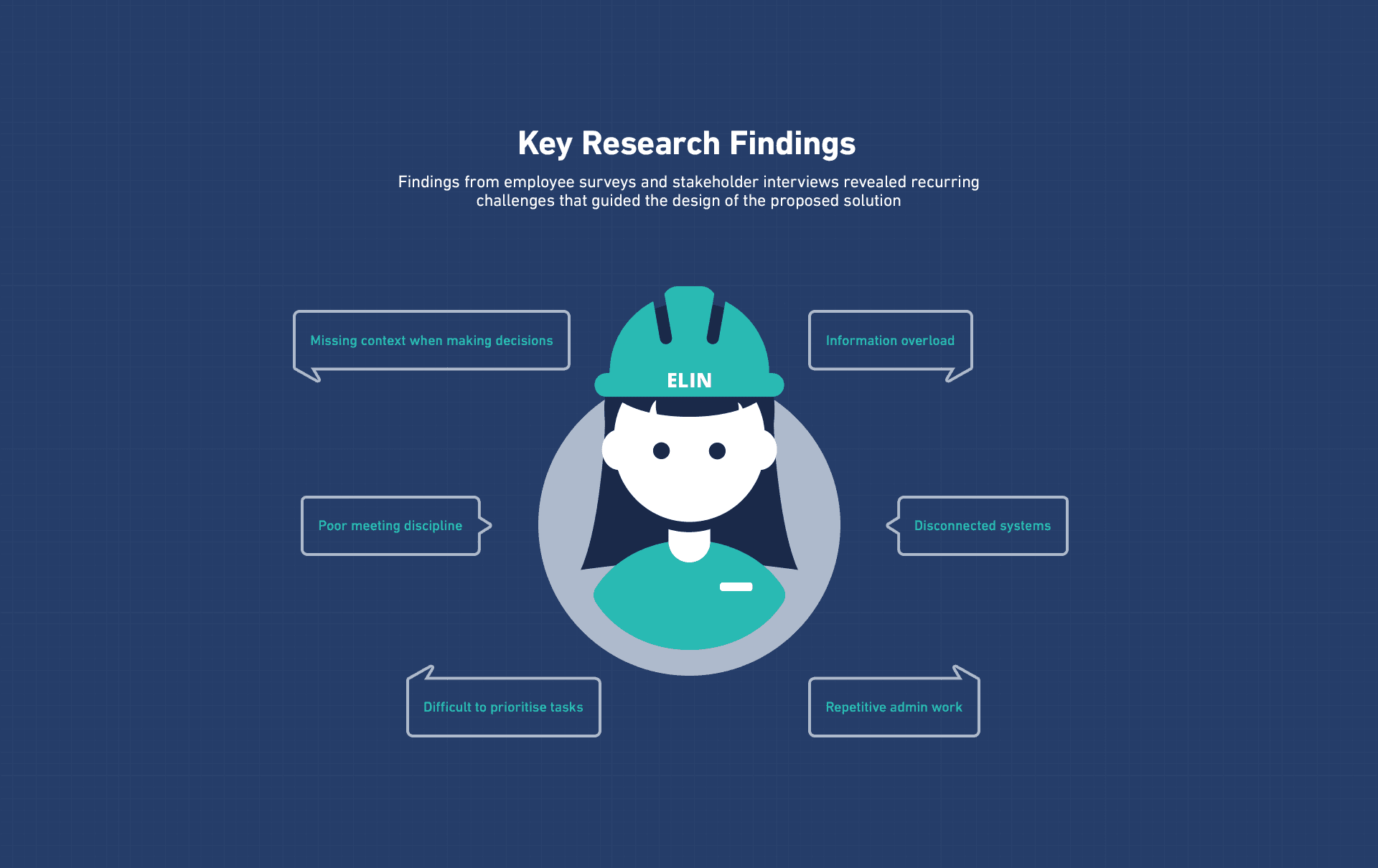
The project began with internal research provided by Skanska, including employee surveys highlighting key pain points in the existing platform. The findings revealed recurring themes:
information overload
disconnected experiences
low engagement
difficulty locating relevant resources
To complement this material, we interviewed employees representing different roles within the organisation. These conversations provided valuable first-hand insights and helped validate assumptions before moving into solution design.
One of my main takeaways was that the existing system attempted to expose too much information at once. Instead of adding more features, I focused on surfacing only the most relevant content and presenting it in a way that supported quick decision-making during a busy workday.
Discovery & Research
The project began with internal research provided by Skanska, including employee surveys highlighting key pain points in the existing platform. The findings revealed recurring themes:
information overload
disconnected experiences
low engagement
difficulty locating relevant resources
To complement this material, we interviewed employees representing different roles within the organisation. These conversations provided valuable first-hand insights and helped validate assumptions before moving into solution design.
One of my main takeaways was that the existing system attempted to expose too much information at once. Instead of adding more features, I focused on surfacing only the most relevant content and presenting it in a way that supported quick decision-making during a busy workday.
Concept Exploration
Early ideation centred around mapping a Project Manager’s daily workflow and identifying moments where contextual information could reduce friction or improve efficiency.
Rapid sketches allowed us to explore adaptive interfaces capable of responding to changing conditions on site, from weather forecasts and workforce availability to material logistics and task progress.
Another direction I actively championed was the introduction of lightweight gamification. Survey results suggested that employees perceived the existing platform as purely administrative and lacked motivation to engage with it beyond necessity. Drawing on previous experience with engagement-driven products, I explored mechanisms such as achievements, progression, and peer comparison to encourage regular interaction without disrupting productivity.
Concept Exploration
Early ideation centred around mapping a Project Manager’s daily workflow and identifying moments where contextual information could reduce friction or improve efficiency.
Rapid sketches allowed us to explore adaptive interfaces capable of responding to changing conditions on site, from weather forecasts and workforce availability to material logistics and task progress.
Another direction I actively championed was the introduction of lightweight gamification. Survey results suggested that employees perceived the existing platform as purely administrative and lacked motivation to engage with it beyond necessity. Drawing on previous experience with engagement-driven products, I explored mechanisms such as achievements, progression, and peer comparison to encourage regular interaction without disrupting productivity.
Material Planning Concept (SMATPOT)
As ideas matured, our team developed a material planning concept called SMATPOT (Smart Multiple Access to Point of Truth).
The proposal connected planning data with logistics to ensure materials arrived where they were needed at the right time. For example, if door installation was scheduled for Thursday morning on the fourth floor, the system could recommend moving materials into position the night before, reducing unnecessary transportation and delays.
The concept aimed to minimise material loss during on-site movement while improving operational efficiency through better planning and coordination.
Material Planning Concept (SMATPOT)
As ideas matured, our team developed a material planning concept called SMATPOT (Smart Multiple Access to Point of Truth).
The proposal connected planning data with logistics to ensure materials arrived where they were needed at the right time. For example, if door installation was scheduled for Thursday morning on the fourth floor, the system could recommend moving materials into position the night before, reducing unnecessary transportation and delays.
The concept aimed to minimise material loss during on-site movement while improving operational efficiency through better planning and coordination.

Low-Fidelity Prototype
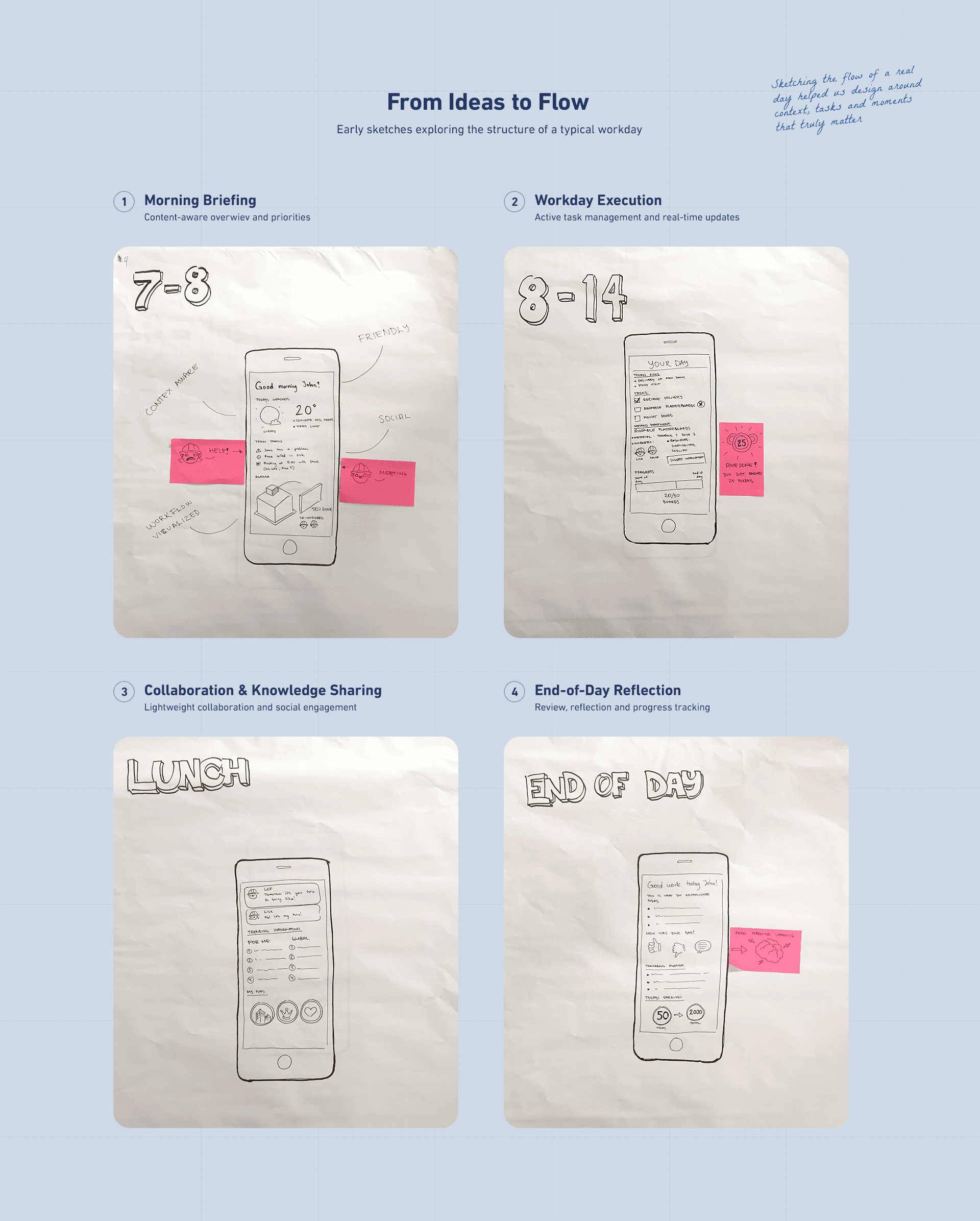
The resulting wireframes focused on four key moments in a Project Manager’s day.
Morning Briefing
The dashboard presented scheduled activities, team assignments, progress indicators, weather conditions, and risk factors relevant to ongoing construction work. Contextual information such as temperature effects on concrete curing or upcoming meetings helped users prepare for the day ahead.
Workday
The interface prioritised active task monitoring, highlighting progress and surfacing potential risks before they became blockers.
End of Day
The day concluded with a concise summary of completed work, team performance, and opportunities to provide feedback through simple interactions such as likes or comments. These signals were intended to support long-term product improvement while giving employees visibility into their own progress.
Social & Team Collaboration
Dedicated moments encouraged collaboration through internal messaging, company news, and lightweight social interactions. Achievement badges and progress indicators were introduced as optional motivational elements designed to reinforce engagement rather than distract from core responsibilities.
Gamification Strategy
Rather than treating gamification as a standalone feature, I explored it as a behavioural design tool that could encourage ongoing engagement with operational processes.
Users could track personal progression, unlock new levels, compare achievements with colleagues, and visualise long-term milestones. The objective was not competition for its own sake, but fostering participation and recognition within everyday workflows.
Low-Fidelity Prototype
The resulting wireframes focused on four key moments in a Project Manager’s day.
Morning Briefing
The dashboard presented scheduled activities, team assignments, progress indicators, weather conditions, and risk factors relevant to ongoing construction work. Contextual information such as temperature effects on concrete curing or upcoming meetings helped users prepare for the day ahead.
Workday
The interface prioritised active task monitoring, highlighting progress and surfacing potential risks before they became blockers.
End of Day
The day concluded with a concise summary of completed work, team performance, and opportunities to provide feedback through simple interactions such as likes or comments. These signals were intended to support long-term product improvement while giving employees visibility into their own progress.
Social & Team Collaboration
Dedicated moments encouraged collaboration through internal messaging, company news, and lightweight social interactions. Achievement badges and progress indicators were introduced as optional motivational elements designed to reinforce engagement rather than distract from core responsibilities.
Gamification Strategy
Rather than treating gamification as a standalone feature, I explored it as a behavioural design tool that could encourage ongoing engagement with operational processes.
Users could track personal progression, unlock new levels, compare achievements with colleagues, and visualise long-term milestones. The objective was not competition for its own sake, but fostering participation and recognition within everyday workflows.

High-Fidelity Prototype
Following the sprint, the concept evolved into a polished high-fidelity prototype enriched with custom illustrations and animations.
My focus was on creating an interface that communicated status clearly, remained approachable under complex conditions, and demonstrated how thoughtful visual design could improve both usability and engagement. The prototype helped stakeholders envision the broader potential of a modern workplace platform beyond traditional project management tools.
High-Fidelity Prototype
Following the sprint, the concept evolved into a polished high-fidelity prototype enriched with custom illustrations and animations.
My focus was on creating an interface that communicated status clearly, remained approachable under complex conditions, and demonstrated how thoughtful visual design could improve both usability and engagement. The prototype helped stakeholders envision the broader potential of a modern workplace platform beyond traditional project management tools.

Outcome & Reflection
The Design Sprint compressed research, ideation, prototyping, and presentation into an intensive two-day collaboration involving multidisciplinary and international teams.
Working under these constraints strengthened my ability to make informed design decisions quickly, communicate ideas visually, and collaborate effectively across different perspectives.
The final concept successfully communicated the product vision and contributed to my company's advancement to the next stage of the competition.
Outcome & Reflection
The Design Sprint compressed research, ideation, prototyping, and presentation into an intensive two-day collaboration involving multidisciplinary and international teams.
Working under these constraints strengthened my ability to make informed design decisions quickly, communicate ideas visually, and collaborate effectively across different perspectives.
The final concept successfully communicated the product vision and contributed to my company's advancement to the next stage of the competition.

My Contribution
Designed the end-to-end concept for the Project Manager experience, from user flows to high-fidelity prototypes.
Translated research insights into clear, task-focused interfaces tailored to on-site construction work.
Created custom illustrations and visual assets that strengthened storytelling and stakeholder presentations.
Introduced gamification concepts to encourage engagement and reinforce positive daily habits.
Worked closely with the team during workshops and the Design Sprint, rapidly iterating on ideas and refining the solution.
My Contribution
Designed the end-to-end concept for the Project Manager experience, from user flows to high-fidelity prototypes.
Translated research insights into clear, task-focused interfaces tailored to on-site construction work.
Created custom illustrations and visual assets that strengthened storytelling and stakeholder presentations.
Introduced gamification concepts to encourage engagement and reinforce positive daily habits.
Worked closely with the team during workshops and the Design Sprint, rapidly iterating on ideas and refining the solution.