Industry
Event Technology and Hospitality Marketplace
Client
Tagvenue • Venue Management CRM
Operational Tools Supporting Venue Managers and Hospitality Teams

Venue Management CRM for Hospitality Businesses
Building a subscription-based CRM designed to help venue managers manage enquiries, bookings, customer relationships, calendars, and operational workflows while helping Tagvenue expand beyond its marketplace business.
Overview
Tagvenue is one of the leading venue booking marketplaces, connecting event organisers with venues across multiple markets.
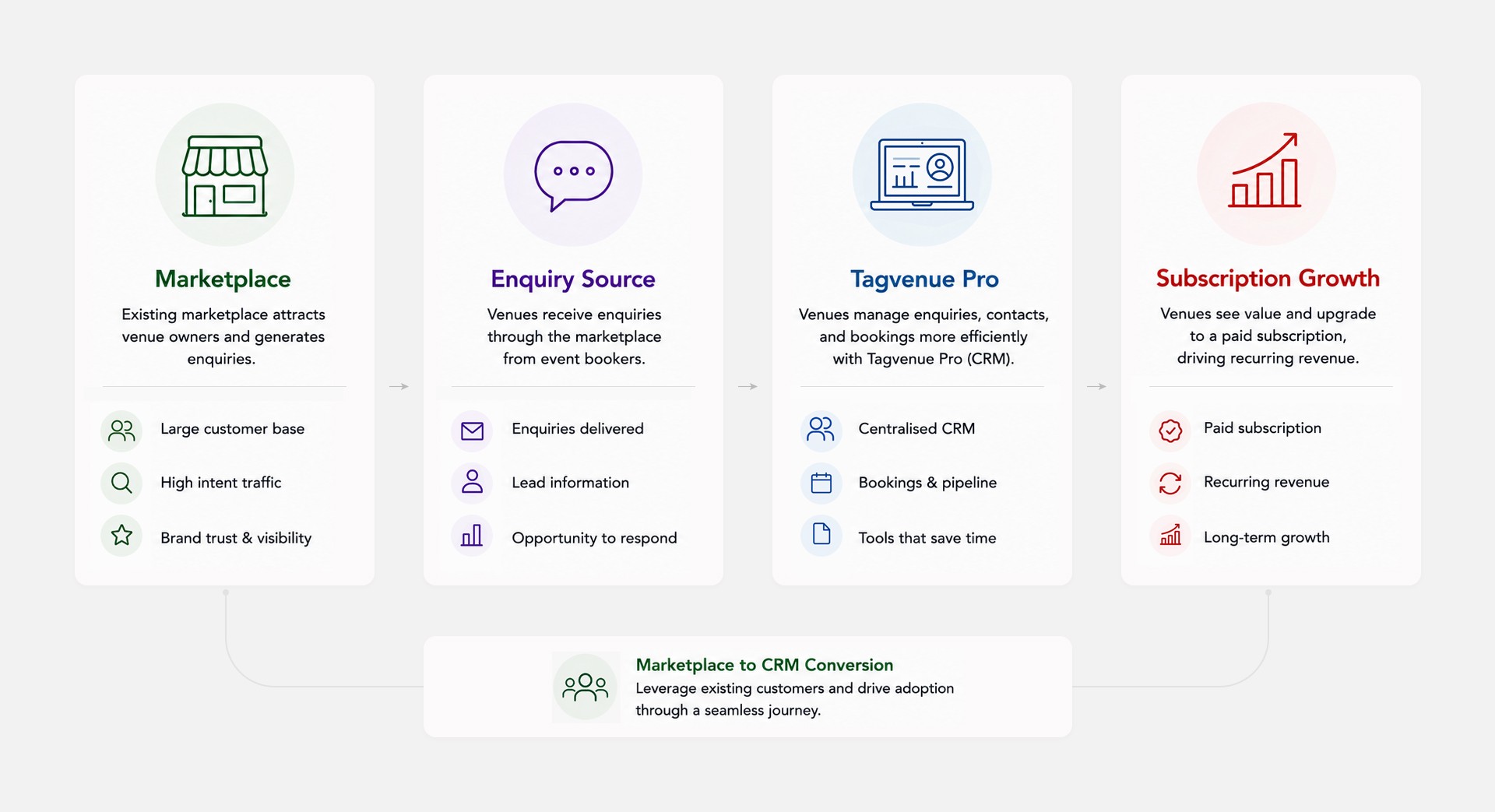
While the marketplace business continued to grow, the company identified an opportunity to diversify its revenue model and build a subscription-based CRM for venue managers.
The initiative became Tagvenue Pro - a product designed to help hospitality businesses manage customer communication, calendars, bookings, documents, and day-to-day operations from a single platform.
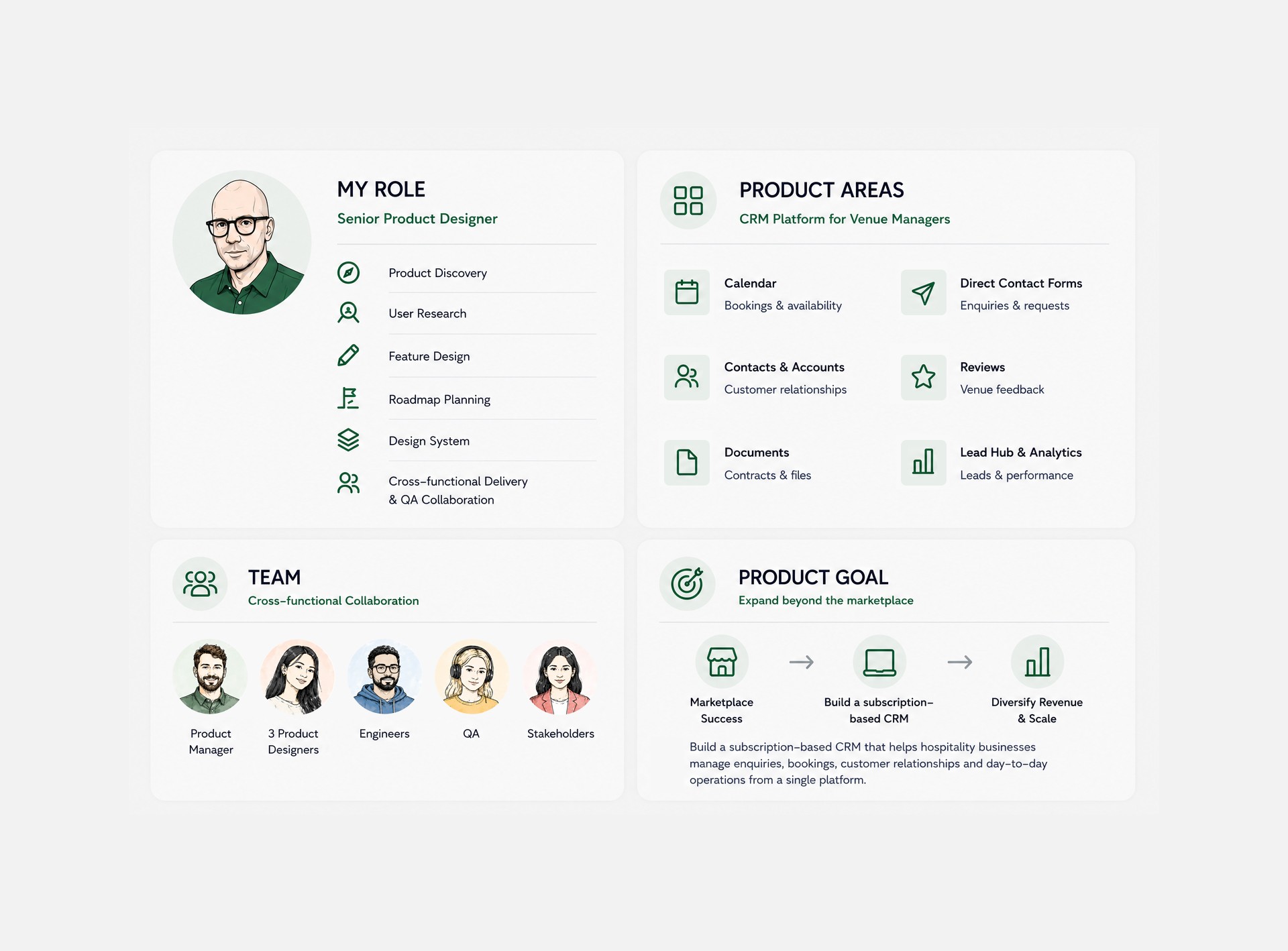
As a Senior Product Designer, I worked across Calendar, Contacts & Accounts, Documents, Direct Contact Forms, Reviews, user research, product discovery, roadmap planning, and cross-functional delivery.
Overview
Tagvenue is one of the leading venue booking marketplaces, connecting event organisers with venues across multiple markets.
While the marketplace business continued to grow, the company identified an opportunity to diversify its revenue model and build a subscription-based CRM for venue managers.
The initiative became Tagvenue Pro - a product designed to help hospitality businesses manage customer communication, calendars, bookings, documents, and day-to-day operations from a single platform.
As a Senior Product Designer, I worked across Calendar, Contacts & Accounts, Documents, Direct Contact Forms, Reviews, user research, product discovery, roadmap planning, and cross-functional delivery.
The Business Challenge
Tagvenue Pro was created in response to a strategic business challenge.
The company wanted to reduce its dependency on the marketplace model and establish a recurring SaaS revenue stream. At the same time, emerging AI-powered search experiences raised questions about the long-term role of traditional marketplaces.
The challenge was not only to build a competitive CRM product, but also to convince existing marketplace customers to adopt it as part of their daily workflow.
To understand the market landscape, the team regularly benchmarked products such as Collins, Tripleseat, Perfect Venue, Guesty, Ivy, and Airbnb.
The objective was clear:
Build a CRM capable of competing with established solutions.
Leverage the existing marketplace customer base.
Create a compelling path from marketplace user to CRM subscriber.
The Business Challenge
Tagvenue Pro was created in response to a strategic business challenge.
The company wanted to reduce its dependency on the marketplace model and establish a recurring SaaS revenue stream. At the same time, emerging AI-powered search experiences raised questions about the long-term role of traditional marketplaces.
The challenge was not only to build a competitive CRM product, but also to convince existing marketplace customers to adopt it as part of their daily workflow.
To understand the market landscape, the team regularly benchmarked products such as Collins, Tripleseat, Perfect Venue, Guesty, Ivy, and Airbnb.
The objective was clear:
Build a CRM capable of competing with established solutions.
Leverage the existing marketplace customer base.
Create a compelling path from marketplace user to CRM subscriber.
Understanding Venue Managers
One of the most important discoveries was that many venue managers were not managing their operations inside Tagvenue.
Instead, Tagvenue often acted as a source of enquiries. Once an enquiry arrived, it was frequently transferred into external systems where the actual operational work took place.
Venue managers relied heavily on tools such as Collins, Google Calendar, Outlook, OpenTable, and internally developed workflows.
Understanding why those tools remained central to their operations became a key research objective.
To support discovery, I conducted and analysed a series of in-depth interviews with venue managers across different business sizes and operational complexities.
The research combined:
User interviews
Competitive benchmarking
Product analytics
Workflow analysis
AI-assisted transcript synthesis
Insights were documented and translated into research reports, feature recommendations, and roadmap foundations used by stakeholders to prioritise future development.
Understanding Venue Managers
One of the most important discoveries was that many venue managers were not managing their operations inside Tagvenue.
Instead, Tagvenue often acted as a source of enquiries. Once an enquiry arrived, it was frequently transferred into external systems where the actual operational work took place.
Venue managers relied heavily on tools such as Collins, Google Calendar, Outlook, OpenTable, and internally developed workflows.
Understanding why those tools remained central to their operations became a key research objective.
To support discovery, I conducted and analysed a series of in-depth interviews with venue managers across different business sizes and operational complexities.
The research combined:
User interviews
Competitive benchmarking
Product analytics
Workflow analysis
AI-assisted transcript synthesis
Insights were documented and translated into research reports, feature recommendations, and roadmap foundations used by stakeholders to prioritise future development.

What We Learned
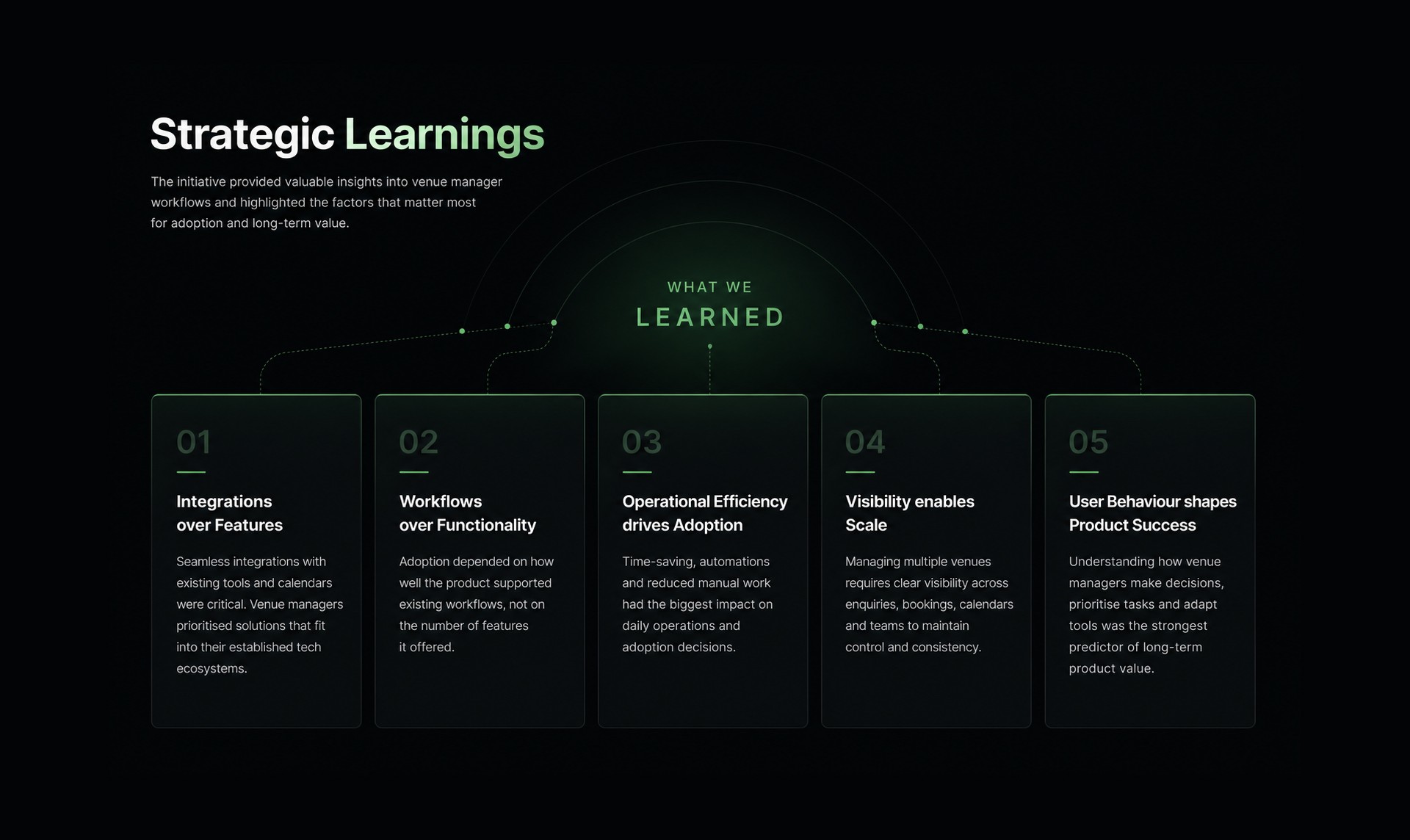
The research revealed that adoption was not primarily limited by missing functionality.
The bigger challenge was workflow displacement.
Users already had established operational ecosystems built around multiple tools and were reluctant to replace them unless a new solution offered clear advantages.
Several recurring patterns emerged:
Heavy reliance on external calendars.
Frequent manual transfer of enquiries between systems.
Strong demand for integrations.
Need for multi-venue visibility.
Preference for editing information without leaving the calendar.
Operational efficiency valued over feature complexity.
Perhaps the most surprising finding was how often venue managers manually moved enquiries from Tagvenue into competing platforms for further management.
This insight significantly influenced future product priorities.
What We Learned
The research revealed that adoption was not primarily limited by missing functionality.
The bigger challenge was workflow displacement.
Users already had established operational ecosystems built around multiple tools and were reluctant to replace them unless a new solution offered clear advantages.
Several recurring patterns emerged:
Heavy reliance on external calendars.
Frequent manual transfer of enquiries between systems.
Strong demand for integrations.
Need for multi-venue visibility.
Preference for editing information without leaving the calendar.
Operational efficiency valued over feature complexity.
Perhaps the most surprising finding was how often venue managers manually moved enquiries from Tagvenue into competing platforms for further management.
This insight significantly influenced future product priorities.

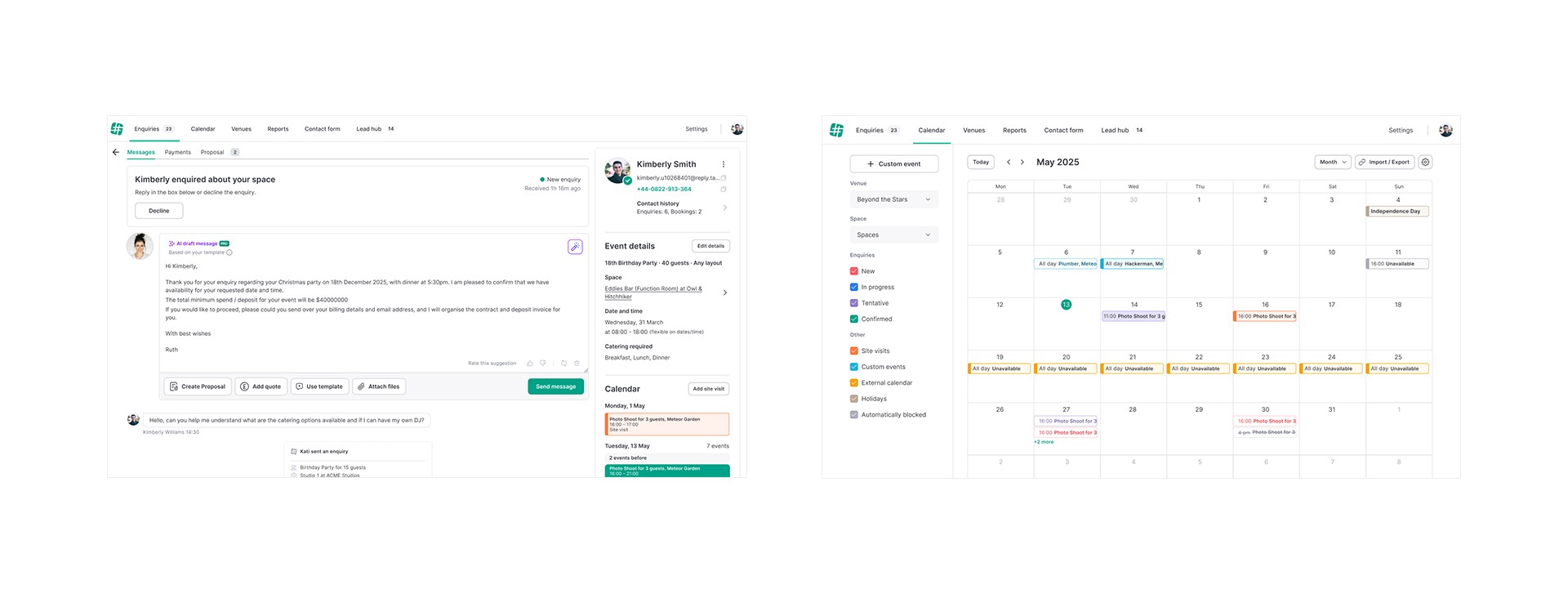
Reimagining the Calendar Experience
Calendar functionality emerged as one of the most critical operational areas within the CRM.
Research consistently showed that the quality of the calendar experience directly influenced whether venue managers perceived the platform as a viable alternative to their existing tools.
The existing calendar suffered from several limitations:
Single venue focus.
No effective multi-space visibility.
Limited integration capabilities.
Weak Google Calendar synchronisation.
Lack of conflict detection.
Limited scheduling flexibility.
Using research findings, behavioural data, and competitive analysis, I redesigned several core workflows.
The work focused on reducing operational friction and supporting the workflows users relied on most frequently.
Reimagining the Calendar Experience
Calendar functionality emerged as one of the most critical operational areas within the CRM.
Research consistently showed that the quality of the calendar experience directly influenced whether venue managers perceived the platform as a viable alternative to their existing tools.
The existing calendar suffered from several limitations:
Single venue focus.
No effective multi-space visibility.
Limited integration capabilities.
Weak Google Calendar synchronisation.
Lack of conflict detection.
Limited scheduling flexibility.
Using research findings, behavioural data, and competitive analysis, I redesigned several core workflows.
The work focused on reducing operational friction and supporting the workflows users relied on most frequently.

Multi-Venue Visibility
Research revealed that larger venue operators needed visibility across multiple venues and spaces simultaneously.
The redesigned experience introduced improved support for complex venue structures and allowed users to understand availability more efficiently.

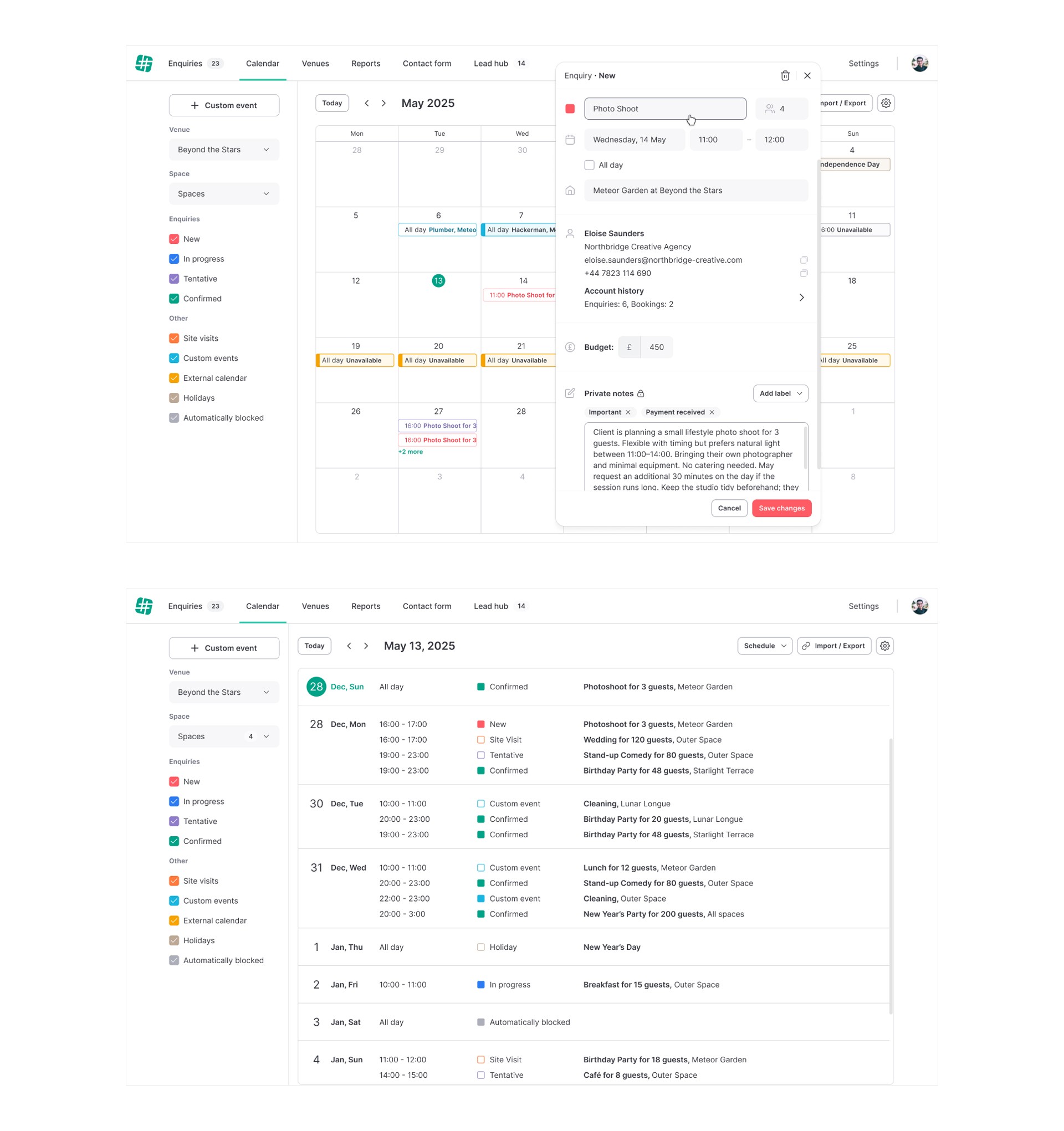
Faster Scheduling Workflows
Users repeatedly expressed frustration with unnecessary navigation and context switching.
To reduce friction, I introduced:
Event editing directly from the modal.
Drag-and-drop scheduling.
Drag-to-resize interactions.
Schedule view.
These improvements helped streamline common operational tasks and reduced the need to navigate between multiple screens.
Improving Event Visibility
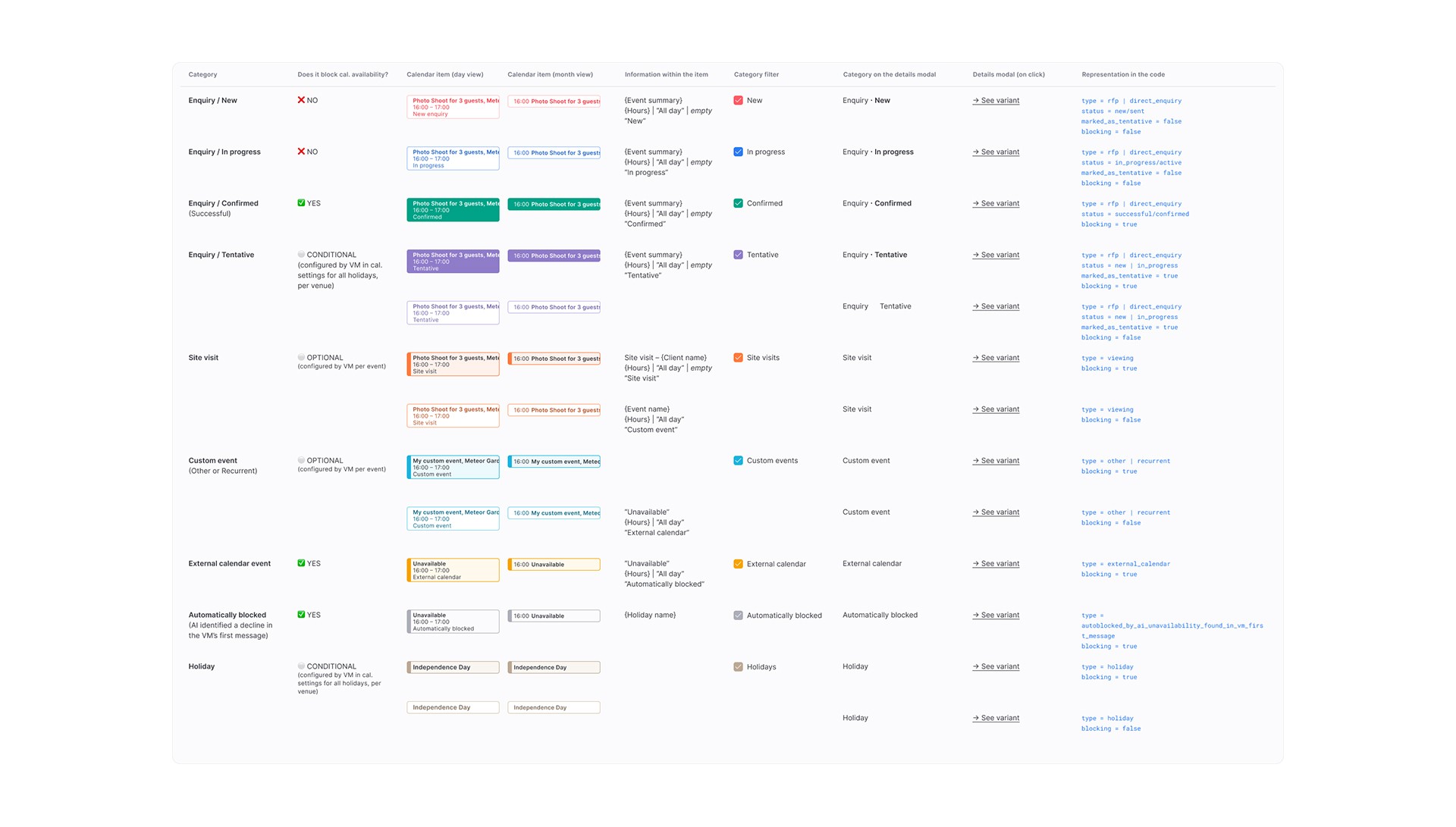
Managing enquiries, tentative bookings, and confirmed events required faster visual recognition.
To support this, the calendar introduced clearer status communication through colour coding and improved event hierarchy.
Design Constraints and Trade-Offs
The calendar was built on top of a commercial third-party framework adapted to Tagvenue's needs.
While this accelerated development, it also introduced technical constraints.
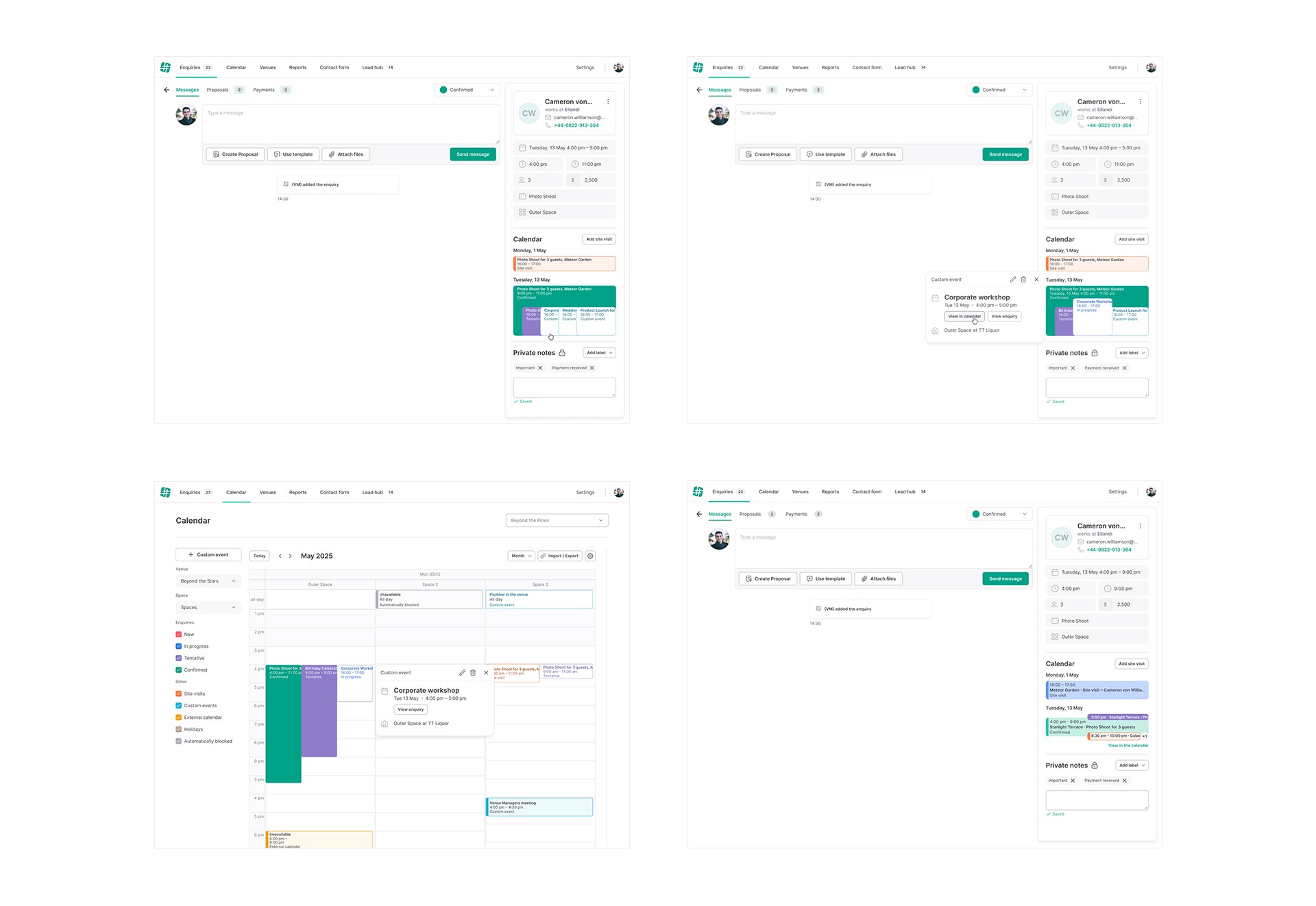
One of the most challenging problems involved overlapping events within day view.
The team explored solutions inspired by Google Calendar, but the complexity of dynamically calculating space allocation for large numbers of overlapping events made a fully equivalent implementation impractical within project constraints.
This required balancing user expectations against technical feasibility, implementation effort, and business priorities.
Beyond Calendar
Alongside the calendar redesign, I contributed to several additional product areas that expanded the CRM ecosystem.
Contacts & Accounts introduced structured relationship management capabilities.
Documents helped venue managers organise operational information and event-related assets.
Direct Contact Forms improved the capture and qualification of incoming enquiries.
Together, these features supported the broader goal of transforming Tagvenue from an enquiry source into an operational platform.
Beyond Calendar
Alongside the calendar redesign, I contributed to several additional product areas that expanded the CRM ecosystem.
Contacts & Accounts introduced structured relationship management capabilities.
Documents helped venue managers organise operational information and event-related assets.
Direct Contact Forms improved the capture and qualification of incoming enquiries.
Together, these features supported the broader goal of transforming Tagvenue from an enquiry source into an operational platform.

Evolving the Design System
As Tagvenue Pro expanded, maintaining consistency across multiple product areas became increasingly important.
Alongside product work, I took ownership of the design system supporting the CRM.
The system I inherited contained duplicated components, inconsistent naming, fragmented documentation, and assets spread across multiple files.
To improve scalability, I:
Consolidated component libraries.
Introduced clearer structure and governance.
Defined scalable naming conventions.
Documented component usage patterns.
Supported Storybook documentation efforts.
Began aligning the system with token-based workflows.
The goal was to create a stronger foundation that could support future product growth while improving collaboration between design and engineering.
Evolving the Design System
As Tagvenue Pro expanded, maintaining consistency across multiple product areas became increasingly important.
Alongside product work, I took ownership of the design system supporting the CRM.
The system I inherited contained duplicated components, inconsistent naming, fragmented documentation, and assets spread across multiple files.
To improve scalability, I:
Consolidated component libraries.
Introduced clearer structure and governance.
Defined scalable naming conventions.
Documented component usage patterns.
Supported Storybook documentation efforts.
Began aligning the system with token-based workflows.
The goal was to create a stronger foundation that could support future product growth while improving collaboration between design and engineering.

Working Beyond Design
My role extended beyond interface design.
I was responsible for driving projects from discovery through delivery, collaborating closely with product managers, engineers, QA specialists, and stakeholders throughout the process.
This included:
User research.
Roadmap contribution.
Jira story creation.
Kick-off sessions.
Design reviews.
Sprint collaboration.
QA support.
Delivery alignment.
The experience strengthened my understanding of product strategy, stakeholder communication, and end-to-end product development.
Working Beyond Design
My role extended beyond interface design.
I was responsible for driving projects from discovery through delivery, collaborating closely with product managers, engineers, QA specialists, and stakeholders throughout the process.
This included:
User research.
Roadmap contribution.
Jira story creation.
Kick-off sessions.
Design reviews.
Sprint collaboration.
QA support.
Delivery alignment.
The experience strengthened my understanding of product strategy, stakeholder communication, and end-to-end product development.

Outcomes
Tagvenue Pro represented a strategic step towards expanding the company’s offering beyond its marketplace model.
The initiative helped validate key assumptions around venue management workflows and provided valuable insights into how hospitality businesses manage enquiries, bookings, calendars, customer relationships, and day-to-day operations.
Through research, product development, and customer feedback, the team gained a deeper understanding of the factors that influence adoption, particularly the importance of integrations, workflow continuity, and operational efficiency. These learnings helped inform future product decisions and contributed to a broader understanding of venue manager needs across the platform.
Outcomes
Tagvenue Pro represented a strategic step towards expanding the company’s offering beyond its marketplace model.
The initiative helped validate key assumptions around venue management workflows and provided valuable insights into how hospitality businesses manage enquiries, bookings, calendars, customer relationships, and day-to-day operations.
Through research, product development, and customer feedback, the team gained a deeper understanding of the factors that influence adoption, particularly the importance of integrations, workflow continuity, and operational efficiency. These learnings helped inform future product decisions and contributed to a broader understanding of venue manager needs across the platform.